The Group has formulated the Risk Management Regulations and outlined the following basic policy on risk management.
- We will maintain an appropriate approach to risk control by, in addition to thoroughly recognizing the importance of risk management, ensuring business management that is based on appropriate operational processes in line with our management policies and strategic targets.
- In terms of risk control, we will continuously engage in initiatives to improve and enhance profitability while making effective use of our limited management resources and maintaining sufficient equity capital in both quality and quantity in light of the overall level of risk.
- For risks recognized as sources of income, we will aim to secure a level of income commensurate with the risks, and for other risks, we will properly evaluate the circumstances, etc. and take appropriate action to address the risks.
- Even in the event of a crisis that cannot be dealt with through normal risk management alone, we will continue to take action, such as determining which operations to prioritize and securing management resources, to ensure business continuity.
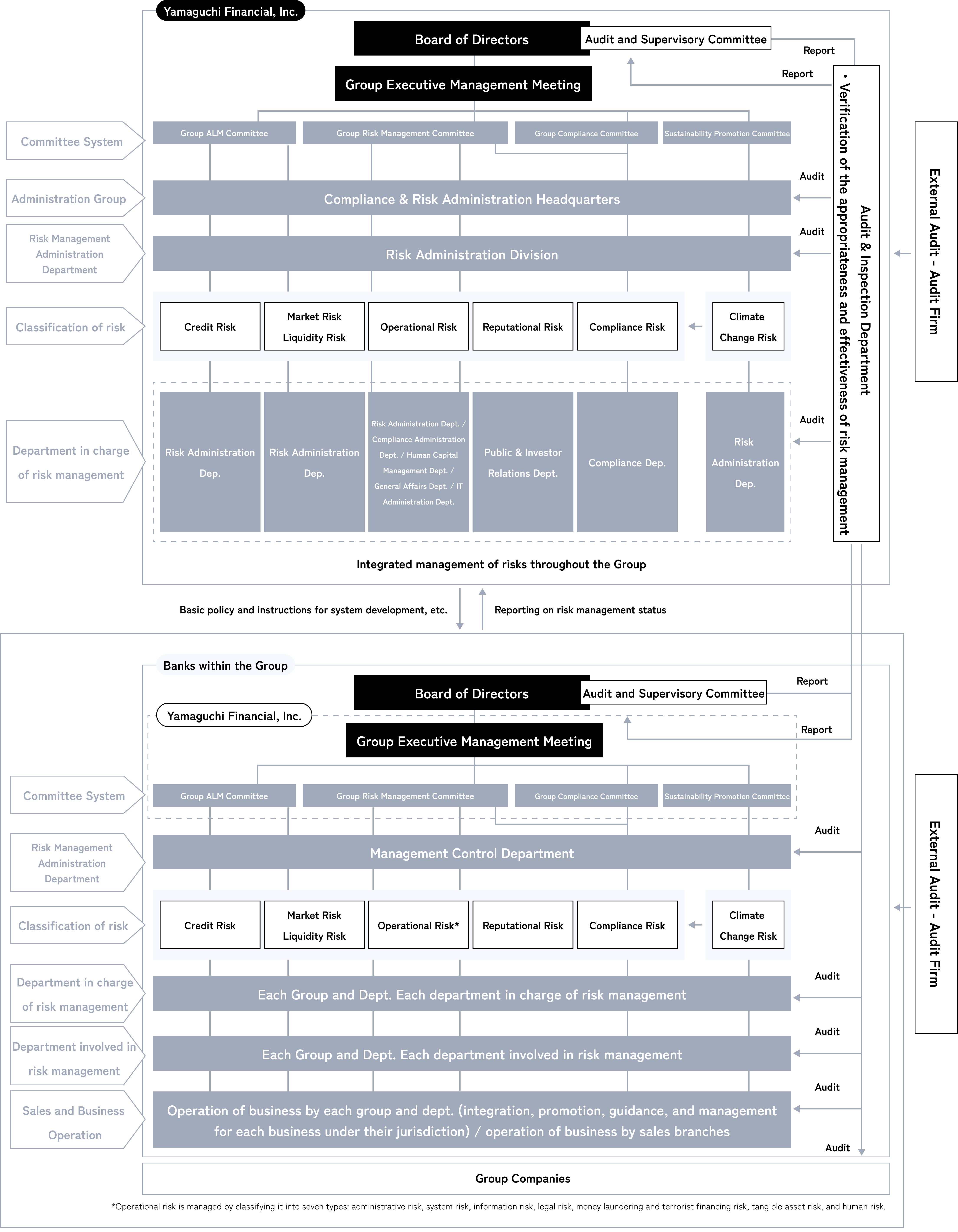
The Group has established and enacted the Risk Management Rules at the Board of Directors meeting, which define the fundamental matters concerning the establishment and operation of our risk management framework.
Specifically, for risks such as credit risk, market risk, liquidity risk, and operational risk, we designate a responsible department for each risk, and we assess, analyze, and evaluate the risk situation across the entire Group for each risk type, and manage these risks. Furthermore, we have established a framework for integrated risk management by discussing countermeasures and other matters at management-level meetings including the Group ALM Committee, Group Risk Management Committee , Group Compliance Committee, Sustainability Promotion Committee, and the Group Executive Management Meeting.
In addition, important matters deliberated by each committee are reported to the Board of Directors via the Group Executive Management Meeting, which exercises oversight.
Moreover, regarding the appropriateness of risk management, audits are conducted by an internal audit departments independent from operation departments.
Risk Management System
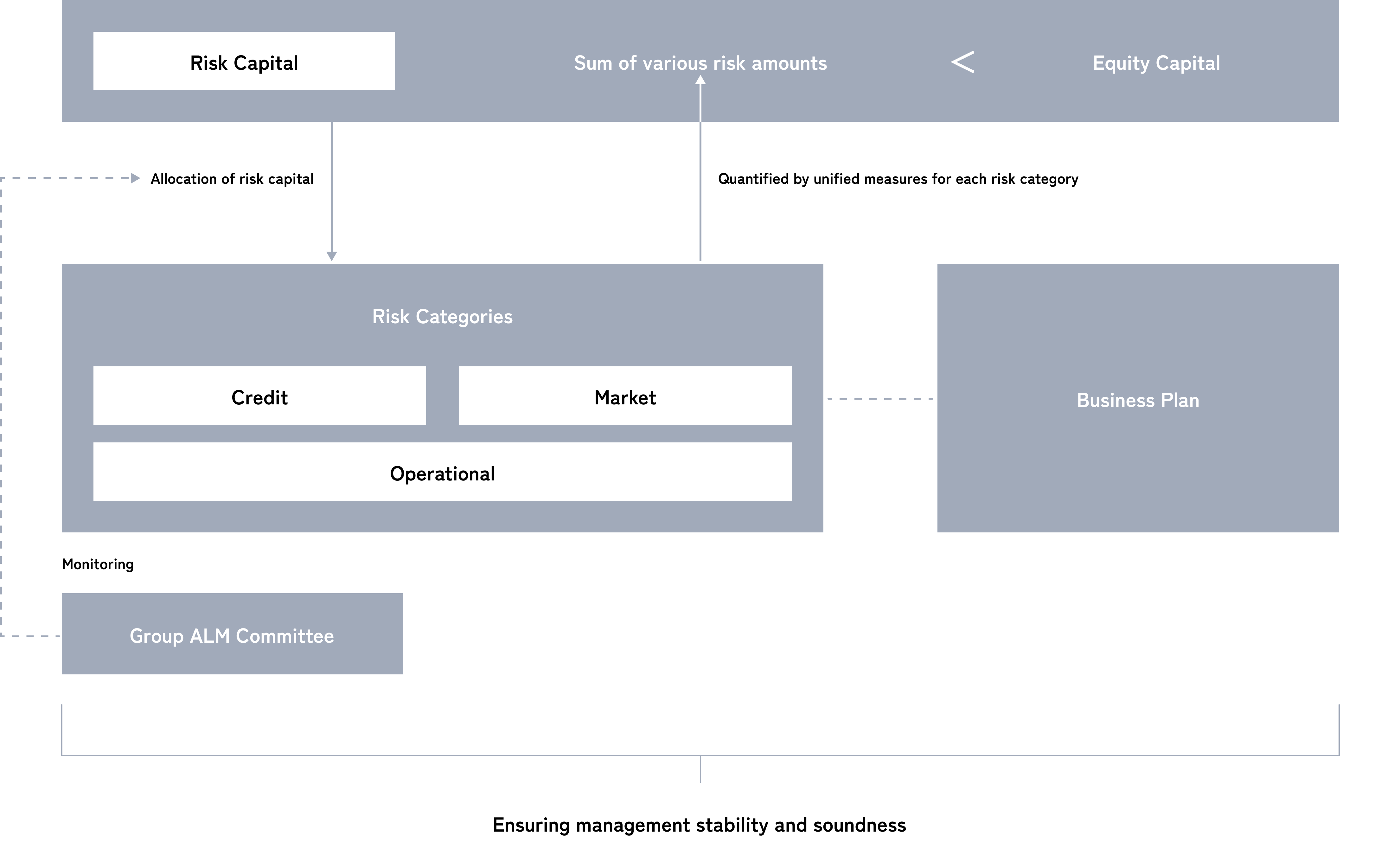
The Group stipulates in the Risk Management Rules that, for all risks we face, we will, to the greatest extent possible, take a comprehensive view of risks assessed by risk category and keep total risk within the range that can be covered by equity capital as the basic policy of our integrated risk management.
We quantify each risk category (credit risk, market risk, and operational risk) based on unified scales of measurement such as VAR (value at risk: maximum potential losses expected during certain holding periods and within specific probability levels) to calculate total risk amounts, and we have positioned risk capital allocation, which keeps risk within the range that can be covered by management strength (equity capital), at the core of our integrated risk management framework.
In our risk capital management, we allocate risk capital to each risk category within the limits of our core equity capital to ensure the stability and soundness of management if risks arise during the execution of our business plans, and we have secured a capital buffer in preparation for risks that are difficult to quantify.
In addition, the allocation amounts of capital to each risk category, transactions, etc., are deliberated and resolved at the Group Executive Management Meeting in the formulation of business plans, and the monitoring of the usage and compliance status of risk capital is conducted by the Group ALM Committee.
Integrated risk management framework
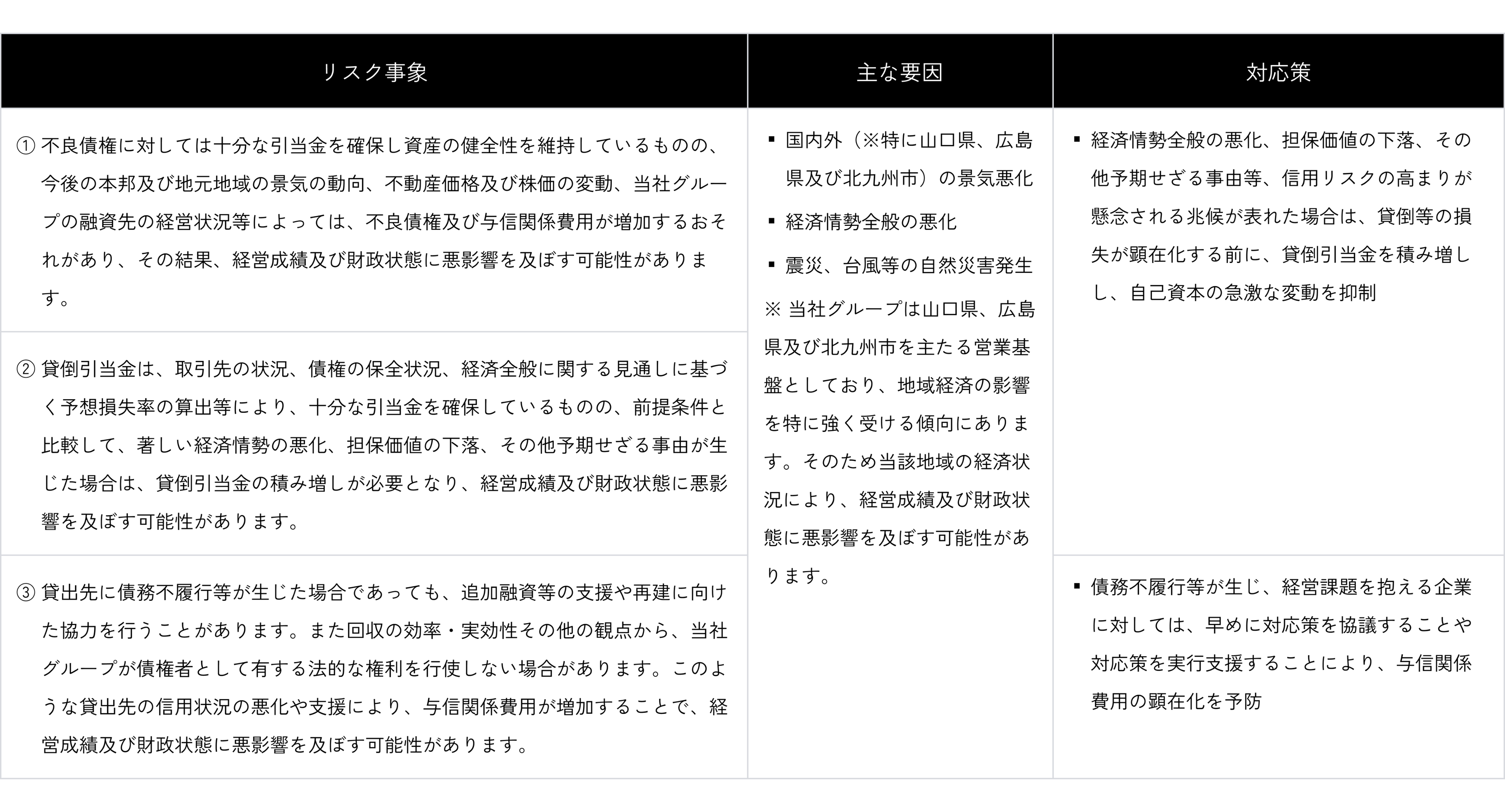
Credit risk is the risk of a decline or the destruction in the value of assets held as a result of a deterioration in the financial condition of customers granted credit, etc. In the case of a credit risk occurring, as this may have a significant impact on the soundness of the Group’s management, particularly strict risk management is conducted on loans that has most of the credit risk. The main risk events, factors, and countermeasures are as follows, and we recognize that (1), (2), and (3) would all have a significant impact on the Group if they occur.
|
Risk events |
Main factors |
Countermeasures |
|
*Since the Group's primary business foundation is in Yamaguchi Prefecture, Hiroshima Prefecture, and Kitakyushu City, it tends to be particularly susceptible to the impact of the regional economy. Therefore, the economic conditions of these regions may adversely affect our business performance and financial condition. |
|
|
||
|
|
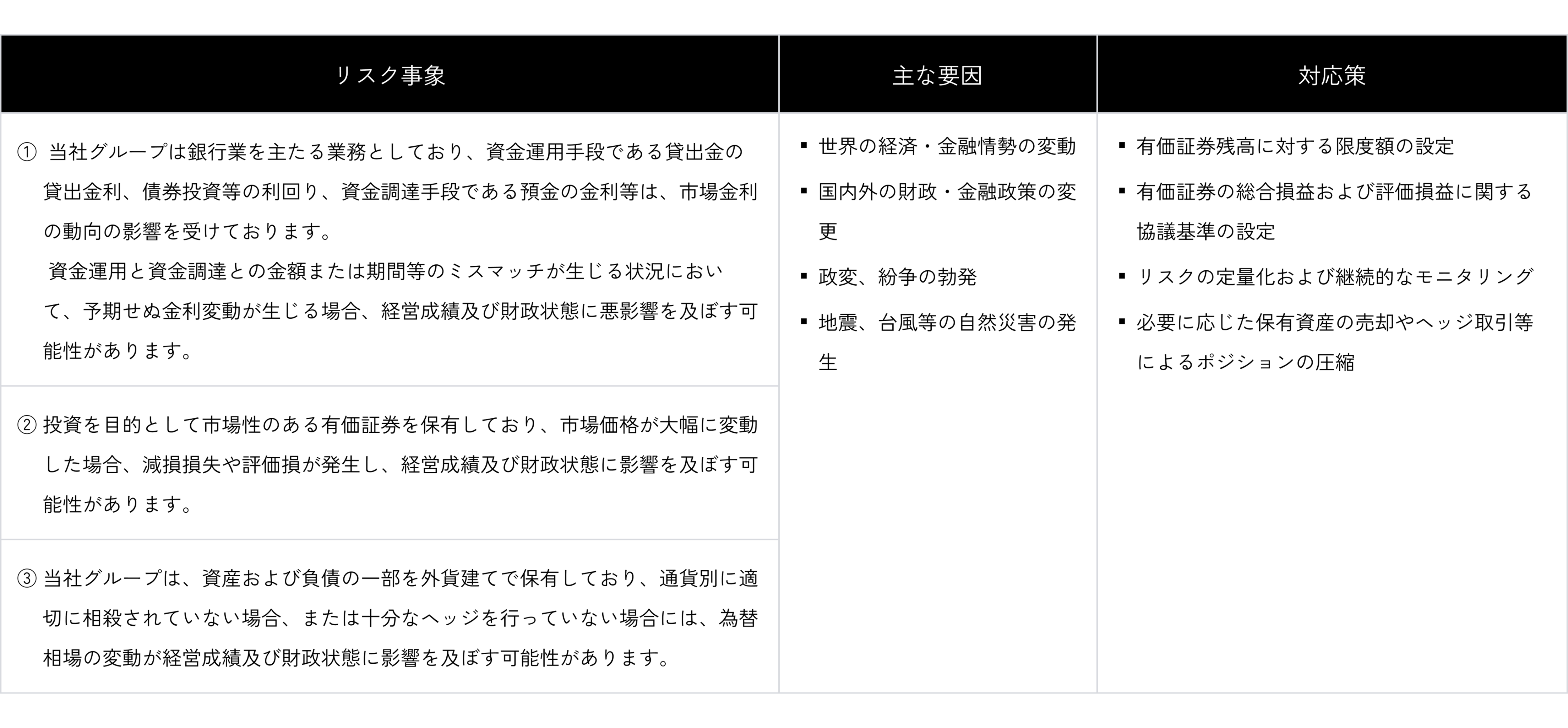
Market risk is the risk of incurring losses due to the fluctuating values of owned assets, liabilities, and offbalance transactions resulting from fluctuations in various market risk factors including interest rates, the price of securities, and exchange rates. The main risk events, factors, and countermeasures are as follows, and we recognize that (1) and (2) would have a significant impact on the Group if they occur.
|
Risk events |
Main factors |
Countermeasures |
|
|
|
|
||
|
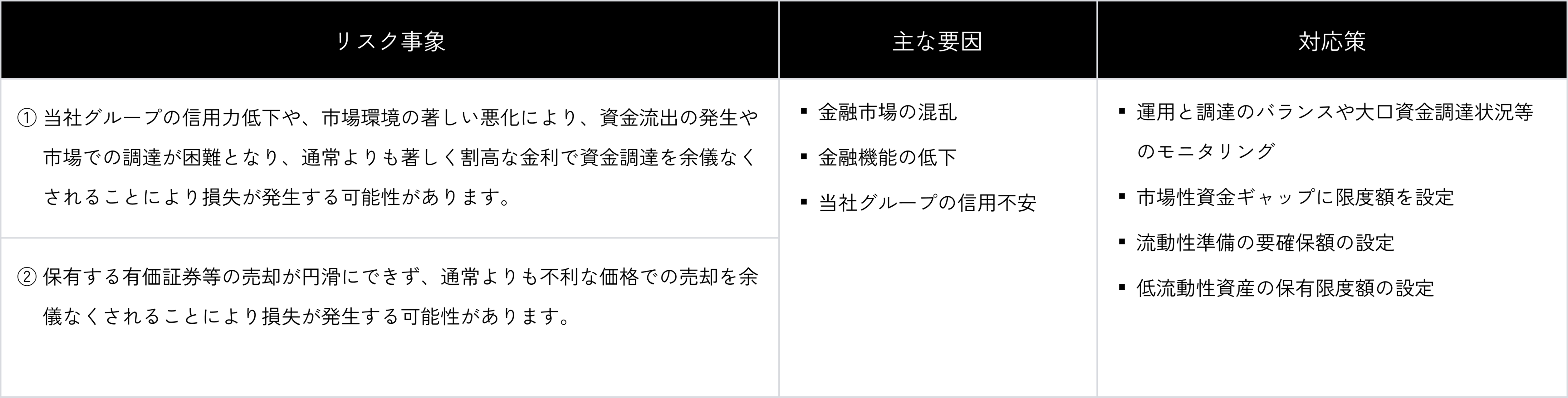
Liquidity risk refers to the risk of incurring losses due to inability to secure necessary funds leading to cash flow difficulties, or being forced to procure funds at significantly higher interest rates than usual due to deterioration in the bank’s financial condition, etc. (funding liquidity risk), as well as the risk of incurring losses due to inability to transact in the market or being forced to transact at significantly unfavorable prices than usual due to market disruptions, etc. (market liquidity risk). The main risk events, factors, and countermeasures are as follows, and we recognize that (1) would have a significant impact on the Group if it occurs.
|
Risk events |
Main factors |
Countermeasures |
|
|
|
|
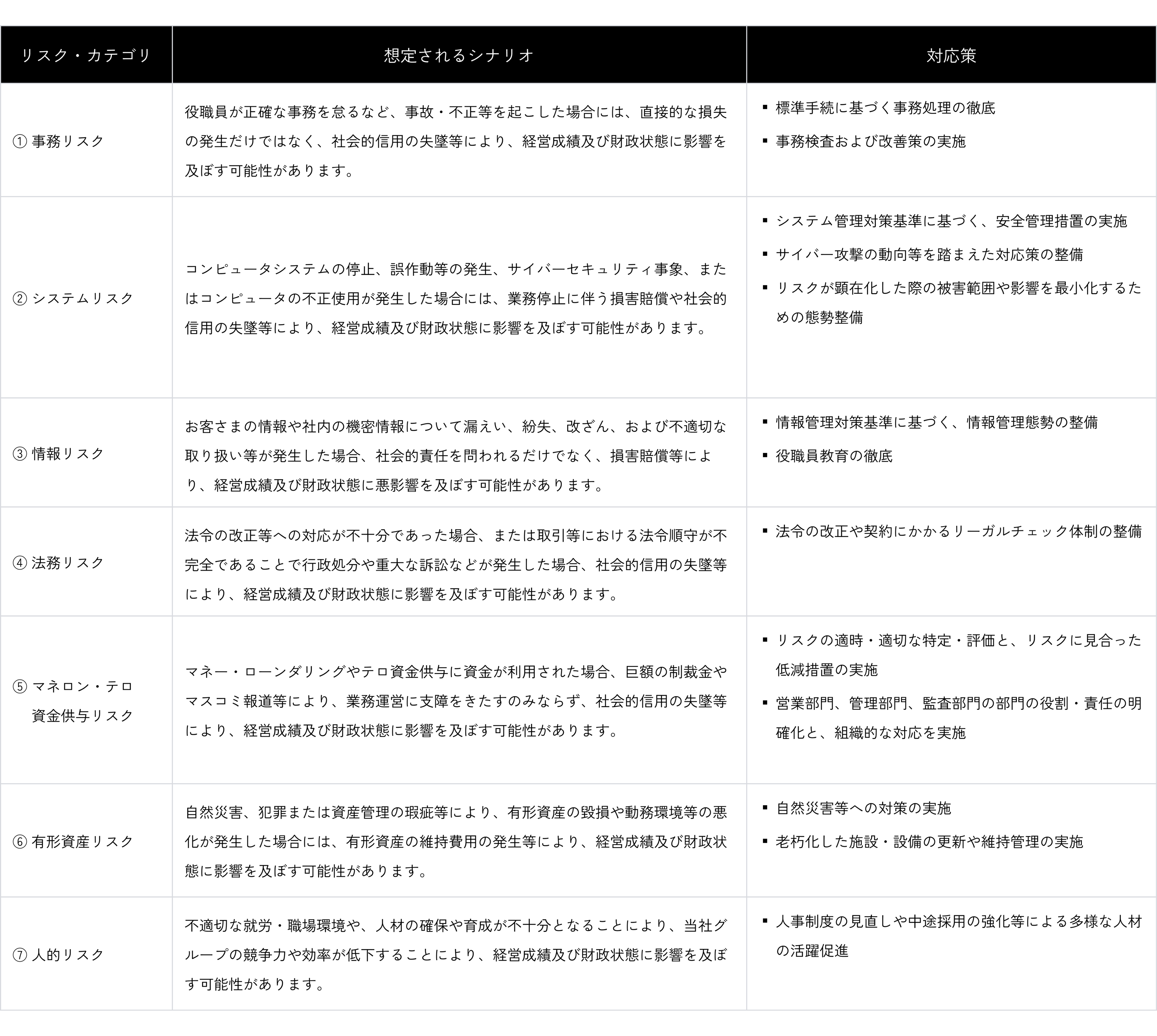
Operational risk is the risk that losses may be suffered due to problematic events occurring in business operations, such as internal fraud, external fraud, inappropriate responses in the working environment (acts that violate laws and regulations, etc.), inappropriate responses in transactions with customers (violations of obligations due to negligence toward customers, problems in product design, etc.), natural disasters, accidents, system failures, inappropriate transaction processing, and inadequate
process management, etc.
Operational risk is divided into the following 7 risk categories and managed. We recognize that (2), (3), (4), (5), and (7) would all have a significant impact on the Group if they occur.
|
Risk category |
Assumed scenarios |
Countermeasures |
|
If officers or employees fail to perform accurate administrative tasks or engage in accidents or misconduct, it may result in not only direct losses but also a loss of social credibility, affecting our business performance and financial condition. |
|
|
In the event of computer system failures, malfunctions, cybersecurity incidents, or unauthorized use of computers, it may result in damages for compensation due to business suspension or a loss of social credibility, affecting our business performance and financial condition. |
|
|
If leakage, loss, falsification, or inappropriate handling of customer information or internal confidential information occurs, it may not only lead to social responsibility issues but also adversely affect our business performance and financial condition due to compensation for damages. |
|
|
If the response to amendments in laws and regulations is insufficient, or if administrative dispositions or major lawsuits occur due to incomplete legal compliance in transactions, it may affect our business performance and financial condition due to a loss of social credibility. |
|
|
If funds are used for money laundering or terrorist financing, it may lead to significant penalties or media reports that hinder business operations and cause a loss of social credibility, thereby affecting our business performance and financial condition. |
|
|
If damage to tangible assets or deterioration of the working environment occurs due to natural disasters, crime, or defects in asset management, it may affect our business performance and financial condition due to the incurrence of maintenance costs for tangible assets. |
|
|
Inappropriate working/workplace environments or insufficient securing and development of human resources may lead to a decline in the Group's competitiveness and efficiency, thereby affecting our business performance and financial condition. |
|